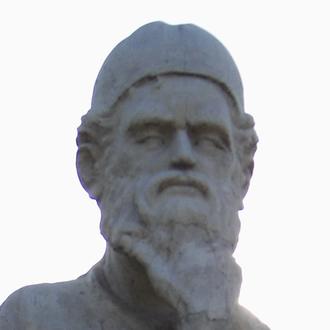
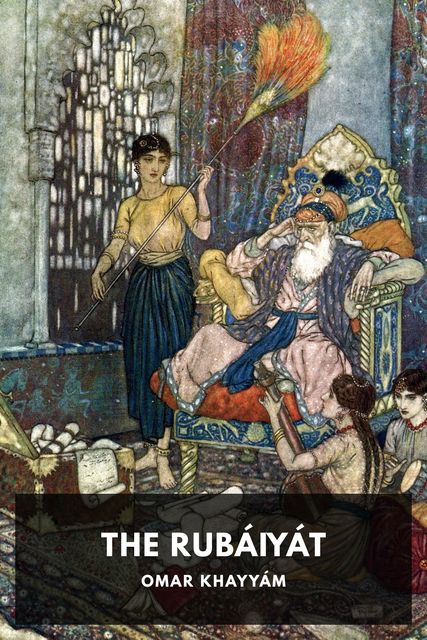
Omar Khayyám was a Persian polymath, scholar, mathematician, astronomer, philosopher, and poet, widely considered to be one of the most influential thinkers of the Middle Ages. He also wrote numerous treatises on mechanics, geography, mineralogy, astronomy, and music.
Born in Nishapur, in northeastern Iran, at a young age he moved to Samarkand and obtained his education there. Afterward, he moved to Bukhara and became established as one of the major mathematicians and astronomers of the Islamic Golden Age. He wrote one of the most important treatises on algebra written before modern times, the Treatise on Demonstration of Problems of Algebra (1070) which includes a geometric method for solving cubic equations by intersecting a hyperbola with a circle. He contributed to a calendar reform.
His significance as a philosopher and teacher, and his few remaining philosophical works have not received the same attention as his scientific and poetic writings. Al-Zamakhshari referred to him as "the philosopher of the world". Avicenna taught him philosophy for decades in Nishapur.